

For modern enterprises to thrive, they need to master six communications skills.
These skills allow businesses, nonprofits, and public agencies to embrace T-shaped problem-solving.
Most companies—especially in technical, specialized fields or with large corporate structures—focus on their “verticals.” That makes sense. In cutting-edge fields like technology, finance, and health care, the competitive value comes from specialists doing things that other people can’t do. Special knowledge and ability offer special value to the company.
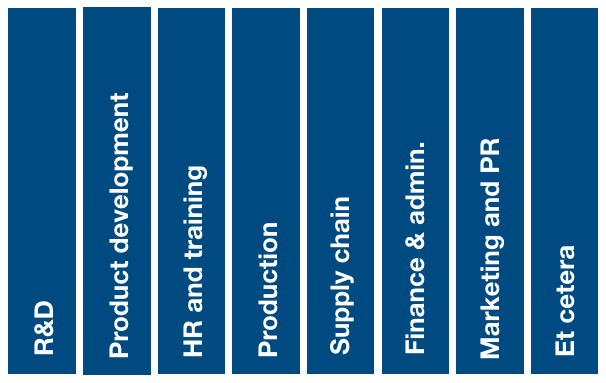
But no matter how good your work inside your specialty, the best organizations foster connections across the silos. McKinsey Consulting uses the T-shaped organizational structure to describe a better way. The horizontal bar of the T represents the connections between the divisions. When a business can provide the depth of expertise of the I’s–and then connect those I’ s with good, smart communication–the company has a chance to do extraordinary things.

Many companies try to improve communications skills in order to improve communication across the organization. They convene task forces and hold staff retreats to bridge the gaps of people in those I silos. They also try to teach communications to their managers. Usually, this means training in writing, presentations, and related communications skills.
But these haphazard approaches will not work. They cannot work. Good communication comes from ongoing development of skills, with deliberate use of those skills. Good communication requires an abiding commitment. It cannot happen only occasionally.
Communications helps people connect across divisions. It could be a company’s the most important competitive advantage.
The Six Skills
So how does this horizontal communication occur? To work at optimal levels, professionals need to master six essential communications skills.
 Conversations—Connecting, with empathy
Conversation is the essential lubrication of business—whether you’re managing a department, selling products and services, or working on a project. People have 27 conversations a day, lasting an average of 10 minutes apiece. That’s 270 minutes–four and a half hours. Talking will always be at the center of professional life. Conversations are give-and-take exchanges, in which the ideas of both sides matter equally. Conversations may have a goal, but they might also be open-ended exchanges oriented toward maintaining a dialogue.
 Interviews—Digging, from the outside in
The more detail and insight you need, the more you need to dig. That’s where interviews come in. An interview is a structured, goal-oriented conversation. Interviews are not equal. What one side needs matters ore than the other. What the other side gives, then, matters more. A good interview is less a give-and-take and more a process of step-by-step drilling, which requires deliberate followup, strategic issue-hopping, clarifications, and connecting dots.
 Presentations—Highlighting issues, simply
A presentation is a conversation of many, led by one or a few people. The trick is to present material that “lands.” As filmmakers understand, an audience can absorb only so much information at a time. So the speaker must provide information in small doses; the audience can them absorb that information and make sense of it in their own way, for their own purposes.
 Emails—Acting, quickly and concisely
Emails are like nudges, with simple presentations of essential information for action. The key to writing good emails is clarity of purpose. Because business professionals take in hundreds of emails a day, they need to understand the purpose by reading the header—and then efficiently read only essential information about one idea in every email.
 Memos and Reports—Signposting, clearly and intuitively
Memos and reports are take-away pieces with one idea but multiple parts. They require thought and reflection, often among many people. A good memo states the One Idea clearly and then organizes the whole piece to state and detail all of the essential considerations for that One Idea. Good memos and reports organize information logically, with clear signposts for skimmers. (Note: All readers are skimmers).
 Public Pieces—Reaching out, engagingly
Communication with outsiders differs from communication with insiders. Public-facing pieces must be, at the same time, more intimate and more general than inside pieces. They must speak to the audience with personality—with concern, empathy, a desire to help, and (often) a dash of humor. So whether you’re writing a speech or a blog post, it helps to imagine one person in the audience. At the same time, the piece must appeal to a vast audience. This requires thinking of all the issues and concerns that your one imaginary person might need or want to know about. It also requires understanding their time frame. Web copy might require extreme conciseness, while a speech could engage the audience for 30 minutes or more.
What are you going to do?
If your business professionals master these skills–which, by the way, they can do in six simple workshops, with followup support–you can transform the connections across the organization.
Nothing else can produce a greater impact, outside your company’s specialized skills and processes.
Do you want to talk? Email Charlie Euchner, the creator of The Elements of Writing, today.