Dennis Cregg, already exhausted, walked to the plate on April 18, 1981, to work a game between the Pawtucket Red Sox and Rochester Red Wings. After spending all day moving from a third-story walk-up to a new house in Webster, Mass., he asked his crew chief for the night off. But another umpire had just been promoted to the Majors. Cregg had to work.
He first crouched behind home plate just after 8 p.m. He kept crouching for more than eight hours, until the 2-2 game between Pawtucket and Rochester was suspended at 4:07 the next morning. It was the longest game, by innings, in professional baseball history — and it still wasn’t over.
The endless game symbolized the trials of life in the Minor Leagues — an often Sisyphean struggle to push a rock up the hill, only to see it come tumbling down again.
At first the game seemed ordinary enough. Both pitchers easily retired the sides. Rochester, the top farm club of the Orioles, took a 1-0 lead into the bottom of the ninth. But Pawtucket tied the game in the ninth to the delight of the announced crowd of 1,740.
“The game was going quickly,” said Joe Morgan, who that year was in his eighth season managing the PawSox. “The pitchers were in control.”
But the game continued. Temperatures fell into the 30s. Winds howled in from the outfield at 30 miles an hour. Rochester players ripped off pieces of the bench to use as firewood. Pawtucket players used broken bats to build a fire in a 55-gallon drum in their dugout. Years later, players remember the sweet smell of burning ash.
McCoy Stadium was a hitter’s ballpark, but that day the balls felt hard and heavy on contact and did not carry.
“When you go up against a good sinker-ball pitcher, the ball is heavy when you hit it,” says Marty Barrett, who played second base for the PawSox. “It seemed like every pitcher who threw that night was a great sinker-ball pitcher. There was no offense.”
Bruce Hurst, who pitched five scoreless innings for Pawtucket, had only one real objective — to keep a sweat.
“I leaned over the fire, I went into the clubhouse, I covered up, I had my hands under my arms,” he says. “Anything to keep the sweat. Once you lose it, you don’t have any chance of getting it back and having any feel for the ball.”
No one scored again until the 21st inning, when Dave Huppert gave the Red Wings a 2-1 lead with an RBI double. But Wade Boggs tied the game with a double in the bottom of the inning.
“God, will this ever end?” Rochester third baseman Cal Ripken Jr. wondered aloud.
Players and coaches pleaded with the umpires to stop the game. Finally, everyone involved in the contest got their wish when they reached the president of the International League, Harold Cooper, who had been at a wedding in Columbus, Ohio. “This is absurd,” he barked into the phone when he learned of the marathon. “Call the game.”
When play was suspended after the 32nd inning — eight hours and seven minutes after it started — the game already was the longest in professional baseball history.
The game continued on June 23, the next time Rochester came to town. Major League players were on strike, so this was the biggest story in all of baseball. The PawSox issued 215 press credentials to see history made, and McCoy Stadium overflowed with 5,746 fans.
Then the game ended abruptly — in the same inning that it had left off. With the bases loaded, Dave Koza singled — his fifth hit in 14 at-bats — to give Pawtucket a 3-2 win.
“It took longer for me to get dressed that day than it took us to finish the game,” says Cregg.
“We were hoping to go seven or eight more innings and really set a record that stood the test of time,” Steve Grilli, the losing pitcher, said after the game.
The game’s 33 innings beat the previous record, set by St. Petersburg and Miami of the Florida State League in 1966, by four innings. The time of eight hours and 25 minutes beat the record, set by the New York Mets and San Francisco Giants in 1964, by more than an hour.
The game used 156 baseballs and set records for the most at-bats (219), pitches (882), strikeouts (60), assists (88) and putouts (195) in a professional game.
Local historians credit the game with stoking interest in the Pawtucket franchise, which had been broke and ignored just two years prior. But the players remember the game’s intensity.
“I knew that the Major League record was 26,” Barrett says. “I remember telling people, ‘We might get the 26 innings.’ You went through a wave of emotions. You get pissed. Then you get punch-drunk and giddy. And then you think, ‘Let’s just try to win it.’ And then you just want to go home. And you go through the emotions again … and again.”
“No one wanted to let the game slip away,” Ripken says. “It’s baseball’s version of sudden death. We got to a point of disbelief in the 16th and 17th innings. Then everyone became more determined to win. It was a test of two teams’ wills. … It became ridiculous. But I remember a persistence. If we were going to be out there, we might as well win this thing. There was a lull, but then both teams became more focused and wanted to win more.”
Yet no one suffered like the poor home plate ump.
“If you’ve ever done 900 deep knee bends, you know what it’s like,” says Cregg, now an instructor for the Professional Baseball Umpires Association. “Physically, it took a while for my legs to come back. I was so sore from doing those deep knee bends for eight hours. The next game was a lot shorter, but I couldn’t run from third base to second.”
Dave Huppert caught the first 31 innings for Rochester, and was so tired that, half-jokingly, he asked Cregg to call 12 straight balls — for either side — to force in a winning run.
The game could have ended four times when runners got thrown out at the plate. Ripken also remembers Boggs snaring two line drives to take away hits. “That’s what the game was like,” says Rich Gedman, who played 13 years in the Major Leagues, mostly for Boston. “Everyone was playing hard.”
Gedman now manages the Worcester Tornadoes of the independent Canadian-American League, and he recalls not appreciating how much it meant for the players to win until years later.
“Even though it was early in the season, we still didn’t want to lose,” he says. “The pitchers threw phenomenally, and the fielders made the plays. Everybody had their chances. It’s what the game of baseball is all about. You don’t realize how special it is at the time because you’re just trying to find an edge and win.”
Stiff winds pushed back balls that would have been home runs on any other night. Ripken remembers thinking Pawtucket right fielder Sam Bowen’s smash was a sure home run.
“It was a bomb, way, way over my head, and I didn’t even bother turning around because I figured, ‘It’s out of here and the ballgame’s over,’” Ripken says. “But the wind ends up blowing the ball back into the park, and our left fielder catches it.”
As Bowen loped by Ripken on the way back to the dugout, he said, “Cal, that was my best bolt. If that’s not going out, we’re going to be here for a while.”
Ripken played all 33 innings, a harbinger of his Iron Man future. On Aug. 10, Ripken would get promoted to the Orioles. The following May he played in the first of 2,632 consecutive games. “That game was symbolic of what my father taught me,” Ripken says. “You go out there to play a game and do everything to win. That game was an extension of that will to play every inning, every day.”
Cregg remembers being impressed by the confidence of players like Ripken, Boggs, Hurst and others. Although they weren’t quite ready for the Majors just yet, Cregg knew that those players were destined for greater things.
“When we were all in Single-A ball, you couldn’t see it as well,” he says, “but we rose up through the system together, and by the time we were in Triple-A, guys like that — and Kirby Puckett and Don Mattingly — they stuck out. They were so good, they made it look like it was a video game. They knew that that wasn’t going to be their final stop, and they were relaxed and waiting their turn.”
Of the marathon’s 41 players, 31 eventually played in the Majors. Boggs entered the Hall of Fame in 2005; Ripken likely will join him in 2007. Others — pitchers Bruce Hurst and Bob Ojeda, infielder Marty Barrett, catcher Rich Gedman — all had solid careers.
The same tenacity that kept the game going enabled players like Ojeda, Hurst, Gedman and Barrett to make it to the Bigs. They succeeded because of their intelligence and drive as much as their athletic talent.
Undrafted but signed for $500, Ojeda secretly ran in the outfield when teammates hit the bars. “I didn’t want to look like a bum so I didn’t tell anybody,” he said. “But I wanted to make the Majors.”
His work ethic won the confidence of Morgan.
After getting rocked in a late Spring Training game between Triple-A and Double-A squads — Gedman hit a grand slam against him — Morgan called Ojeda into his office. “He said, ‘You know, kid, I know you did horsebleep yesterday, but there’s something about you,’” Ojeda remembers.
Barrett — whom Hurst calls the smartest player he ever saw — was acutely aware of the thin line separating Major Leaguers and Minor Leaguers. His brother, Tommy, collected more than 1,000 hits in the Minors but got just 84 at-bats in the Majors, with Philadelphia and Boston. Modestly or not, Barrett said his brother “was pretty close in talent to me, but I was in the right time and place.”
Boggs was stuck in the Minors on that fateful night. He went 4 for 12 and went on to bat .335 for Pawtucket on the season. But Boston did not make Boggs a September call-up.
“Some players get labels, like, ‘He’s a Triple-A player,’” Ojeda says. “Wade was like that. He hit and hit and hit. But some people in the organization didn’t believe in him. He was left off the 40-man roster. Anyone could have had him for $25,000.”
Boggs was mystified by the snub but fought on. Teammates remember Boggs coming to the park at 1 p.m. for night games. “He’d have buckets of balls, and he would concentrate on placing them,” Hurst remembers. “You’d see one ball in right and dozens of balls in left.”
Boggs got his chance when third baseman Carney Lansford injured an ankle in June 1982. Boggs hit .390 the rest of the season. Lansford was soon traded.
Other players had lesser careers but stayed in baseball. Dallas Williams went hitless in 15 plate appearances for Rochester — 0 for 13 with two sacrifice bunts. Still, he hit .283 before getting called up to Baltimore. He played in 20 Big League games and now is a hitting coach for the Ottawa Lynx of the International League. “I hit the ball good seven or eight times that night,” he says. “I’ve had longer 0-for streaks — everyone has. We weren’t thinking of hits, we were trying to score.”
By the time the game was suspended, only 23 fans remained. The PawSox management rewarded them with season passes to McCoy Stadium.
In retrospect, this record game shouldn’t have happened. The rulebook states that no inning should begin after 12:50 a.m. Both sides pleaded for a suspension of the game, but crew chief Jack Leitz did not have a complete copy of the rules on hand.
“I believe in fate and I believe in destiny,” says Ojeda, who pitched the 33rd inning and got the hard-fought win. “That’s just the way things had to work out that night.”
For Rene Gerard, life was an infinite process of reflecting others to gain affirmation. How do stories reflect this “mimetic” understanding?
When George Babbitt begins his relationship with Tanis Judique, he is thrilled to step outside the staid conservative conventions that have governed his life. Tanis is an exotic Bohemian, alien but alluring to this frustrated middle-aged man.
George is the real-estate broker and staid family man in Sinclair Lewis’s classic Babbitt. George imagines himself to be a player in Zenith. But he is really a follower who succeeds by reflecting the expectations and values of others.
As George shows Tanis a rental apartment, they move easily into agreement:
They agreed that the weather would soon turn cold. They agreed that prohibition was prohibitive. They agreed that art in the home was cultural. They agreed about everything. They even became bold. They hinted that these modern young girls, well, honestly, their short skirts were short.
To George, the moment feels rebellious. Staid old George is flirting with a sexy, Bohemian young woman. But George is no more authentic than before. He is just taking his cues from a different source. His excitement comes not from any real freedom, but from mutual attunement. Lewis says of his creation: “The assurance of Tanis Judique’s friendship fortified Babbitt’s self-approval.”
We’ll come back to George. But now, to see what’s happening in that apartment, we need to explore a raducally different figure: the French literary scholar Rene Girard.
Imitation and Identity
As Girard argued, the most distinctive quality of people is their constant imitation of others. We are forever mirroring others. As storytellers, we need to figure out how to reckon with this reality.
This attunement begins early, with the first dim awareness of other minds and other lives. A process of “mirroring” shapes how we perceive the world and our place in it. It becomes part of the story we tell ourselves — about who we are and how the world works.
Storytellers, philosophers, and psychologists tend to depict people as unitary beings: “She’s ambitious,” “He’s popular,” “They’re a tight couple.” But in fact, characters move within a shifting set of social pressures and influences.
Girard had a name for this pattern: mimetic desire. We want what others want, often because others want it. The implications are wide-ranging, from personal rivalry to social conflict.
For storytelling, the implications are immediate. Characters are not simply defined by traits or goals, but by the networks of attention and imitation in which they are embedded. What they want — and how those wants change — depends on who they are watching, who is watching them, and how those lines of influence intersect.
But mimetic desire is a dynamic process. It doesn’t simply move in twos, with two sides imitating the part of the other they would like to be. It evolves into triangles and, eventually, includes whole communities.
The Triangle
Desire never runs in a straight line from individuals or pairs. It runs through a third point: the model.
George doesn’t want what he wants because of some quality intrinsic to it. He wants it because Tanis wants it, or seems to. The triangle is subject (George), model (Tanis), and object (a Bohemian lifestyle).
If the model stays at a safe distance (what Girard called “external mediation”), this is comfortable. Americans can admire their distant heroes (from George Washington to Muhammad Ali) and ideals (from the flag to the MAGA hat). The distance keeps this desire safe, domesticated, unthreatening.
But when a model is close, that model can spark conflict. Two people can imitate each other’s taste in skirts indefinitely. They cannot, for long, both have the same job, the same recognition, the same person’s exclusive attention. What pulls people together, eventually, pulls them apart. The object of attract can become the object of conflict.
What follows is a pattern Girard discussed under a term he borrowed from Freud: the narcissism of small differences. The closer two rivals are, the harder they work to assert difference, even as their behavior becomes identical. Each escalates to outdo the other. Both are now organized entirely around the same prize. Girard calls this process “doubling.” They are two mirror images (similar), but opposed to each other (competing).
In the process of competition, the original object doesn’t matter so much anymore. The two sides are not fighting over the object, but about being chosen. The object turns almost arbitrary, swappable for whatever the rival wants next, because it was never really the point.
Sometimes its easiest to see this process in politics. After World War I, hatred of the Kaiser was replaced by hatred for Bolsheviks. After the Cold War, hatred of the Soviets was replaced by hatred of “terrorists.” We see it now in England, with seven revolving-door prime ministers since Brexit. Most recently, Keir Starmer’s landslide vistory has curdled into hatred—and the rise of memetic opposite in Andy Burnham.
When the Crowd Loses Its Edges
So the natural attraction of two bodies—based on desire, mirroring, a need to matter—evolves into a triangle. And then it spreads to whole communities.
Alexis de Tocqueville, author of the prescient Democracy in America, offers a preview of Girard’s memetoc theory.
Tocqueville, an aristocrat in America to study prison reform, was amazed by what he called “the “equality of conditions” in America. This land, without fixed positions or wealth, offers a wide-open territory for the economic, social, and political success. Americans are the ultimate can-do pragmatists. When they see a stream that needs bridging, they get together and bridge it. Inside a community, this spirit engulfs all.
But as Tocqueville notes, there is a dark side to this story.
With no external authority, public sentiment becomes the authority. People stop forming their own judgments and start triangulating off what “everyone” thinks and desires. To be recognized by the group, a person also has to reflect the group back. That reciprocity turns conformity into tribalism. We see this tribalism in stories like Nathaniel Hawthorne’s The Scarlett Letter, Shirley Jackson’s “The Lottery,” Arthur Miller’s Death ofa Salesman, and more.
The Quiet Weapon
What happens to the person who doesn’t enter the mirroring contract—who refuses to pick a side or escalate a fight? What happens to the person who maintains an independent identity, while everyone else is bound by groupthink?
That might look like the safest position of all, but it isn’t. That outlier becomes a scapegoat (or, to switch animal metaphors, the black sheep). By not conforming, the dissenter exposes others—and himself. By violating the group’s orthodoxy, the outlier makes everyone feel uncomfortable. So the group freezes him out—or even seeks to destroy him.
As Tocqueville notes, a group doesn’t need law or force to enforce its collective values. Contempt and isolation are usually enough. “I know of no country in which there is so little independence of mind,” he wrote of America. It was a process of mutual censorship, which became self-censorship—a society policing itself through the threat of exile.
The Battle of Forest Hills
So what does it look like in action? Consider a revolt against public housing in Forest Hills, N.Y., in the 1970s. It offers a parable for Girard’s memetics or Tocqueville’s tyranny of the majority.
New York City proposed three 24-story public housing towers for Forest Hills, a solidly middle-class Queens neighborhood. Opposition developed instantly. City officials did not vet the proposal with any community process. The people were taken by surprise. So they revolved.
But rather than keeping the debate on these issues, the opposition quickly developed a scapegoat: the poor, mostly minority people who would move into these apartments. And the rhetoric turned radical and hateful. To the opponents of housing, the city government was the Gestapo targeting innocent Jews. Public meetings turned into obscene attacks.
Eventually, Mayor John Lindsay appointed a young law processor named Mario Cuomo to mediate the dispute. He got the project cut in half. The deal made his career. But make no mistakes: Cuomo’s process did not wipe away the extreme rhetoric or hatred. But it did kept the disagreement a disagreement, rather than an all-out war.
(The essay is the first in a series on memetics and storytelling.)
In the first two parts of this series, we have seen how Rene Girard’s insights play out in different contexts: Babbitt in Zenith, Huck on the raft, and the three condemned people in No Exit.
So what can writers do to use these insights when they build their own stories? How can memetics provide a process for building a great story?
Here are five principles to consider:
1: Find the Story’s Mediator
Every character wants something. The mimetic question isn’t what they want. The question is: Who showed them to want it? And also: Is this model a potential rival?
In Wanting, a study of Girard’s work, Luke Burgis imagines a community called Celebristan. This is a place where our life models exist apart from everyday life: models, athletes, movie stars, and influencers. You can want what they want without threatening to take it from them, which means you can admire without friction.
Now think about your early days in college: Freshmanistan. Here, the models are nearby. In college, that could include the hot athlete, the brainy student, the rad prof, or the stunning coed. Here, competition can be intense. Competing with a roommate in Freshmanistan is different than admiring a distant star in Celebristan.
Status comes from being extraordinary, not useful. In The Theory of the Leisure Class, Thorstein Veblen describes this as “conspicuous. consumption”: using things to show off. In his day, that could be long fingernails (which indicated no need to work). In our day, it could mean an absurd consumer object, like a Hummer, a heliport, or a custom outdoor kitchen.
Questions for the storyteller: Who is your character’s model? Is the model in Celebristan or Freshmanistan? If Freshmanistan, what happens when both reach for the same thing? And if there are two models — is the character aware of the contradiction they’re living inside?
2: Watch what happens when memetic desire wanes
The hardest move in mimetic plotting isn’t building rivalry. It’s catching the moment when the rivalry’s original object quietly stops mattering.
Part 1 described this: once two rivals are locked in doubling, what’s actually being fought over is no longer the prize but the rival’s gaze — being chosen, being first. The object becomes almost arbitrary, swappable for whatever the rival wants next. When that slide happens, it rarely announces itself with a speech. It shows up in a hesitation, a shift in what a character notices, a new character or idea suddenly receiving the intensity that used to be directed elsewhere. These are the small tells that tell the reader more than the characters know about themselves.
The slide has three distinct causes, and each produces a different story:
Exposure. The model turns out to have clay feet, and the veil tears. This is the oldest pattern in hero worship: the admired figure who gets close enough to be fully seen, and turns out to be ordinary, or worse. The desire doesn’t necessarily die here. What dies is the model’s ability to carry it. The desire migrates — often to a purer, overcorrected version of the same fantasy, because what the imitator was attached to was never the person but the transformation the person seemed to promise. The new model has to promise the same thing more credibly.
Foreclosure. The model stays intact, but the path to the object closes — economically, structurally, sometimes simply generationally. The desire doesn’t migrate to a new model; it finds substitute objects that perform fidelity to the original model’s values on a smaller scale. Michael Kinsley argued this memorably in The New Republic in the 1980s, when the yuppie generation was getting nothing but contempt: have some compassion for them, he wrote, because they can’t have what their parents had — the house, the car, the one-income family — and the expensive wine and the vacations aren’t self-indulgence, they’re tribute. A scaled-down performance of belonging to a value system they still believe in, aimed at an object they can’t reach. George Babbitt is here too: the gadgets, the boosterism, the relentless performing of “player” — a man imitating a model of success that was never quite available to a man of his position to begin with.
Flight. The model simply moves on. Georg Simmel described this with characteristic precision in his 1904 essay “Fashion”: the moment a lower class adopts a style, the upper class abandons it, not because the style has become worse but because it has become common. The model’s desire was never fixed to the object itself — it was fixed to what the object marked, which was distinction. Once the imitator closes the gap, the object stops doing that work, and the model is already chasing whatever still separates them. This produces the hollow arrival: a character who achieves the thing, and finds the thing’s value has already left. They got to the table just as everyone interesting stood up.
The diagnostic question for a writer isn’t which of these is happening. It’s: have you written the moment when you can feel the desire shifting — when a reader watching carefully can see it before the character does?
3: Identify the Boundary
Every storyworld has boundaries. The type of boundary determines how fast the mimetic process runs.
Physical boundaries are porous and slow: people move across them, carry their models with them, establish hybrid cultures on the edges. Professional, religious, and political boundaries are firmer and more self-policing — membership is legible, defection is visible, and the group maintains itself through real consequences for crossing. Virtual boundaries are the fastest and most porous of all, for a reason Sennett couldn’t have named in 1977 but would recognize immediately: in digital communities, the mirroring itself is constant and visible in a way face-to-face mirroring never was. A like is performed agreement. A share is public identification. An absence is already a statement. The cycle that once ran across months of social pressure now runs across hours.
For a storyteller, the practical question isn’t just what kind of boundary your storyworld has. It’s what your storyworld’s boundary is made of — what qualifies someone as inside it, and what exposes them as outside. Forest Hills in 1971 was nominally a physical boundary (a neighborhood), but the community’s internal cohesion was also professional, ethnic, religious. The pressure held from multiple directions at once. What gives a storyworld its texture isn’t any single boundary but the overlapping of several, and the story lives in the places where they don’t quite coincide.
The diagnostic question: what would it cost your character to step even partway out of the mirroring contract their community runs on? Can you price it specifically — in relationships, reputation, livelihood, self-image? If you can’t, the boundary isn’t real enough yet.
4: Decide Who Gets Targeted
Memetic conflict almost always leads to someone getting targeted for blame and ostracism. The question is who, and by what means.
The scapegoat can be overt: expulsion, violence, the full theatrical apparatus of communal punishment. Or it can be Tocqueville’s version — the quiet kind, the withdrawal of regard, the civil death that leaves the body intact and hollows out everything else. The reverend’s gleaming eyes in Babbitt’s last scene are the quiet kind. The Good Citizens’ League turning their backs in Babbitt’s office is the quiet kind. No blood, no spectacle, just the sudden absence of belonging.
The storyteller’s decision here isn’t only who becomes the target — it’s whether they’re a genuine outsider or an insider who stepped back from the mirroring contract. Girard’s point is that the most exposed person in a contagion isn’t necessarily a stranger. It’s often the person who was inside the mesh and tried to exit it — whose non-participation reads as a verdict on everyone who didn’t.
A second decision follows from the first: Does anyone actively manage the targeting? The mechanism exists independently of malice. But once it exists, it’s available to anyone who can correctly identify or manufacture a target and harvest the unity that follows. The story changes considerably depending on whether the community finds its own scapegoat through purely emergent pressure, or whether someone is steering it.
The diagnostic question: at the crisis point of your story, what happens to the person who won’t enter the contagion? Have you written what that refusal costs them, and who notices?
5: Choose the Resolution
Mimetic crises resolve in one of three ways.
The community finds a scapegoat and discharges its tension, temporarily, at someone’s expense.
The crisis continues unresolved, with the characters learning to live inside it — which is No Exit’s ending, bleak and honest.
Outside contact intervenes: real, sustained engagement with someone on the other side of the boundary, the kind that turns elimination into contestation.
This last possibility–which break the spell–is the most interesting. It suggests a way out. That way out is friction and positive conflict.
In The Uses of Disorder, Richard Sennett argues that conflict is the ultimate teacher. When we face conflicts everyday, on a scale we can understand and manage, we develop an ability to navigate the world. When we create barriers to conflict–in gated communities and speech codes–we udnermine our capacity to think and act.
Matthew Crenson confirms this insight in Neighborhood Politics. When residents battle each other every day — zoning, schools, who gets what — they can develop stronger civic bonds.
William Connolly’s agonistic democracy gives this a theoretical name: the antidote to antagonism is better contest, not less contest. You stay in the fight over meaning, over what the community is and who it includes, with someone you may never agree with, while admitting your own deepest commitments are contestable too.
For a storyteller, this is the hardest resolution. Characters can’t hug their way out of genuine mimetic crisis. The contact has to be specific, costly, and sustained enough that the reader believes the stakes of it — believes that the two people across the boundary from each other are actually changed by the encounter, not just softened. Huck can’t reform society but he can tear up the letter. That’s Twain’s version of earned contact: small, irreversible, private, and real.
The diagnostic question: if your story ends in contact and not a scapegoat, what is the exact moment the intervention happens, who pays for it, and how does the reader know it’s real rather than convenient?
Coda: The Try This
In every scene, someone’s approval matters — and that pressure is reshaping what the character wants, how they perform it, and what it would cost them to stop. Track the model, the object, the distance, and the boundary. Watch for the moment the object stops mattering. Know what you’re building to, and what kind of resolution you’re willing to earn.
That’s the whole toolkit. Not a formula. Just a way of seeing more of what’s already there.
To understand the dynamics of Rene Girard’s memetics–and their implications for storytelling–consider three very different narratives.
Babbitt’s Closed Worlds
After a lifetime as Zenith’s most famous conformist, George Babbitt has taken up with a sexy bohemian named Tanis Judique. No longer a reflexive conservative, he has decided he likes short skirts and jazz and dancing cheek to cheek. For once, George is making decisions for himself.
Well, not exactly. In fact, Babbitt has exchanged one style of conformist behavior for another. The wild side he has embraced, on the sly, has just as many mirrors in it as the one he left.
Zenith never really lets Babbitt be himself. To be sure, Babbitt would not know how to be himself if he had the chance. Think of the groupings that constrain his behavior:
His family, wife Myra and his grown children, ensconced in their Dutch Colonial house in Floral Heights.
The Athletic Club and the Boosters, his conservative business peers, the men he lunches with and sells real estate alongside.
Tanis and her Bunch, the late parties, and the giddy, deliberate, boozy looseness.
The Good Citizens’ League, formed explicitly to bring men like Babbitt back into line.
When Babbitt tries to claim some room of his own — “that strikes me as my private business” — he pays a heavy price. He loses clients, the Zenith Street Traction Company among them. Gunch, once a friend, crosses the street when he sees him.
Moving into Tanis’s world also carries real costs. The deeper he gets, the less it feels like freedom and the more it feels another set of expectations. The giddiness of the affair and the wild nights need just as much mirroring as the straitlaced respectability of Babbitt’s old business pals.
Eventually, he returns to the fold. In the novel’s final chapter, Babbitt seeks reassurance from his pastor.
“I just wanted to ask — Tell you how it is, dominie: Here a while ago I guess I got kind of slack. Took a few drinks and so on. What I wanted to ask is: How is it if a fellow cuts that all out and comes back to his senses? Does it sort of, well, you might say, does it score against him in the long run?”
He’s not asking about his soul — he’s asking about acceptance. And Reverend Dr. Drew obliges him with exactly the wrong kind of attention: “Been going on joy-rides? Squeezing girls in cars?” His eyes glistened.
The story comes full circle. One memetic figure has confirmed another. The order of the world has been restored — not because Babbitt found his way back to anything true, but because he found, once again, an audience willing to tell him who he was.
Heroism in Memesis
Huck Finn looks, on the surface, like the easiest case in this series: a boy who simply doesn’t care what people think. He defies the Widow Douglas’s attempts to “sivilize” him almost on instinct, slips away from Pap with barely a backward glance, fakes his own death without much remorse.
None of that costs him anything, because he never accepts these boundaries. The Widow is an authority he can dodge. Pap is a model only in the sense of showing Huck exactly what he doesn’t want to become.
The real boundary doesn’t emerge until partway down the river, and it isn’t a person at all. It’s “the larger swirl”: the whole inherited weather of a slaveholding society, absorbed so early and so completely that Huck experiences it not as someone else’s opinion but as his own conscience.
The crisis arrives in Chapter 31. The duke and the king have sold Jim back into captivity, and Huck, alone on the raft, decides to do the “right” thing and write to Miss Watson, telling her where to find him. He writes the letter. He feels, he says, washed clean, light as a feather, ready to pray for the first time in his life.
But then he hesitates. He remembers his time with Jim on the river, in moonlight and in storms, talking and singing and laughing. “I see Jim before me all the time,” he says. Now Huck can’t go through with his plan. He picks up the letter, holds it, and tears it up. He has been taught to expectat damnation for such defiance. “All right, then, I’ll go to hell,” he says.
How did Huck come so close to turning in Jim? Huck’s rationale for turning in Jim in was never really his; it’s the whole town’s opinion, internalized so thoroughly he mistook it for his own voice.
When he gets home, Jim has already been treed. But Tom Sawyer, ever the jester, plays a joke on Huck. He pretends that Jim is in captivity and stages a rescue plan. Tom’s fake adventure is just another form of memesis: Tom, having no other model, follows an absurd plan based on adventure tales. No matter that Jim is disrespected and Tom is hurt in the process.
In the end, Huck’s Aunt Sally is planning to adopt Huck to finish the civilizing the Widow started. The first round of memetics didn;t work; maybe this one will. Huck leaves: “I reckon I got to light out for the Territory ahead of the rest, because Aunt Sally she’s going to adopt me and sivilize me, and I can’t stand it. I been there before.”
No Exit
If Huck shows now to exit a bad memetic world, Jean-Paul Sartre shows what happens when there’s no way to escape.
Sartre’s No Exit shows three characters, recently dead and condemned to the surprising hell of a drawing room. Garcin is a journalist executed for desertion, Inez is a postal clerk who seduced her cousin’s wife, and Estelle is a socialite who drowned her own infant.
How can this room be hell? Where are the fiery wasteland or the burning lake of Milton? When the door shuts, it eventually dawns on the characters that “hell is other people”–confined together, condemned to play out memetic conflict forever.
Sartre builds a closed triangle out of exactly their mutual dependency: Estelle wants Garcin to want her, because a man’s desire is the only proof of her own beauty. Garcin wants Inez to believe he wasn’t a coward, because Estelle’s good opinion is worthless to him. And Inez wants Estelle, who can’t stand her.
Each needs the other, memetically. None of them can get what they need, making the third into a scapgoat.
The play’s most famous line–“Hell is other people”–isn;t the misanthropic claim that some readers hear. It refers, instead, to the discovery that when you identity depends on someone else, you have surrendered your selfhood.
Aristotle’s narrative arc has stood the test of time. After all, he expressed this model of drama about 2,500 years ago, in The Poetics. But actually, this approach goes back ever further in time.
Long before Aristotle, humans followed a basic 1-2-3 process to navigate and understand the world. Brain researchers have confirmed this process: perceive, process, resolve. The specifics vary depending on the format (email, memo, report, web copy, etc.). The specifics also vary depending on how narrative, reportorial, or analytic your piece.
Now, let’s get a sense of the universal 1-2-3 story structure:
Part 1: Prompt. Show or tell the reader what you’re writing about and why. State a problem. Introduce us to the key issues or characters. Maybe hint at how it will work out–at least, what factors might help to resolve the matter.
Part 2: Process. Work through the issues. Break them down into manageable pieces. Work your way up to the more difficult aspects of the problem. Reveal the contradictions and conflicts. Explore some of the possibilities for solving the problem.
Part 3: Resolve. Figure it out. The resolution could be positive or negative. It could leave some loose threads. One way or another, complete the journey.
Let’s get into a little more detail.
Part 1: The Beginning (‘World of the Story’)
Begin your piece with a bang. Whether you’re writing a simple email or a longer piece, state the issue or problem right away.
Start by showing the “world of the story.” Show the characters in their natural habitat, with a view of their values, habits, and concerns.
Grab the reader’s attention, instantly, in one of two ways:
Provide a vignette that distills the major issues at stake in the piece.
State the challenge, as directly and succinctly as possible. Make sure that the audience knows, right away, why reading this piece will be worthwhile.
As much as possible, be vivid and sensual. Help the reader to see, hear, and feel what’s going on. Be specific; as much as possible, talk about particular people, at a particular time and place, facing particular challenges, with particular results. Avoid the temptation to talk in abstractions or generalities.
Part 2: The Middle
This is the most important part of your piece. If you have set it up well in part 1, the reader will be ready to dive in to explore even difficult topics.
The Body, With Background, Definitions, and Evidence
The heart of your email/report/proposal/whatever is your breakdown of the problem into three or more parts (usually), with explanation of each one.
What’s the best order for these parts? It depends.
From Big to Small: Sometimes it’s easiest to talk about the biggest, most important and inclusive part of the issue.
In Ascending Complexity: On complicated issues, with lots of moving parts, it often makes sense to build from ground up–starting with the easiest ideas that people can easily understand, then moving to more and more difficult spinoffs of these ideas.
By Category or Segment: On some topics, all of the aspects of the issue might be equally important and complex. If you’re describing the tasks of a corporate team on a project, everyone plays an essential role (e.g., product development, production, marketing, distribution, accounting, etc.). So just describe each as fully as necessary.
Chronologically: Sometimes, we best understand an issue by understanding its development or evolution.
No matter what you do, show the characters taking on more and more complex or difficult issues. A story is a progression. People can only take on one thing at a time. They can only address the hardest issues after they have addressed smaller issues.
• A Note on Definitions
Especially in specialized fields, you may need to define terms. You can do this in three ways: parenthetically, in paragraphs, and in side discussions. If you can define a term simply (that is, with just a few words–knowing that the reader will understand you right away), you might use parentheses. If it’s more complex, you might step out oif the flow of your writing and devote a short paragraph to the definition. Sometimes, you want to offer a detailed definition without losing the flow of your prose, so you create a definition in a sidebar.
• A Note on Evidence
Be clear about what evidence you provide. Scientists might report on laboratory results. Economists or marketing folks might use case studies or statistical analyses. Theorists might break down ideas analytically, using logical analysis to make sense of things–looking for commonalities and contradictions, sharpening definitions, and the like.
Fine. But as much as possible, show your evidence in specific, concrete, and sensual terms.
Counterarguments and Complications
In most professional or academic work, it’s likely that readers will have objections or at least questions. Show respect by raising and addressing those points.
Part 3: The End
In the end, we often want to look forward. So we might speculate about reform or change. Rather than just understanding and issue, we might consider some “what if?” scenarios.
Scenario thinking offers a useful way to do this. Business and planning professionals often use scenarios to sketch out different possibilities for the future. No one can predict the future of course; as Stewart Brand notes, “All predictions are wrong.” But we can consider the far-out extreme possibilities–the absolute best and worst possibilities–and prepare for both.
Options
When you offer the reader options, you take a step toward engaging them–and bringing them to your side of the issue. Consider the different between a mother asking her child “What do you want for breakfast?” versus “Do you want macaroni or a hamburger?” The choice creates involvement.
If possible, reduce the options to three distinct choices–or three clusters of choices. Try to label these choices or clusters with simple, clear labels.
Next Steps/Call to Action
Say exactly what should be done now–with specific assignments and dates for action to be completed. For larger initiatives, indicate phases of action–short-term actions, near-term actions, and long-term actions. As much as possible, be specific.
Conclusion/Summary
Finally, sign off. Conclude, perhaps, by referring back to the opening image or question. Summarize your findings and the options suggested by your piece.
AND ANOTHER THING . . .
Depending on the document, readers might want a coda. Many appreciate getting references, so they can follow up on the ideas you have offered. Many also appreciate other resources, such as professional contacts or programs, that they can use.
References and Resources
If useful, provide references–especially those that allow the reader to dig deeper to explore the issue.
Some reports describe their methodology–how they gathered information, how they analyzed it, why it’s valuable … as well as its explanatory limitations.
Also list other resources, including organizations and programs that can help people educate themselves and take action.
For Further Discussion
Some pieces close with a brief discussion of related topics. Academics, in particular, list ideas for future research.
Appendices or Exhibits
On issues with complicated evidence or analysis, it often helps to offer appendices with charts, tables, graphics, and even quotations.
Identify the issues that might be explored next. In academic writing, scholars often suggest next phases for research. Business writers often suggest new areas for R&D or new markets to pursue. A look ahead often reinforces the importance of the present document.
Ask most people what a story is and they will describe a sequence: this happened, then that happened. Ask a writer and you will usually get something sharper: a series of conflicts, and conflicts that produce some change in the world. That answer is better, but it still misses what storytelling actually does.
Storytelling is a way of sharing a reality that moves toward a reckoning.
A story hands the reader a world in which characters are trying to address the challenges of their lives. That world may contain conflict as we usually understand it, or it may not. What it must contain, eventually, is a reckoning.
The reckoning is the moment a character can no longer avoid responding to the pressure the story has built. That pressure can arrive through open conflict, but it doesn’t have to. It can come through seeking, through pursuit of something not yet understood. It can come through nothing more dramatic than accumulation, one event settling on top of another until the weight demands an answer.
And here is the part that makes stories feel true: the character can be expected to refuse. To deny that there is a problem at all, or to deny that changing their behavior is possible. That refusal is not a flaw in the character or a delay in the plot. It is the plot. We recognize it because it is how people actually behave under pressure, ourselves included.
The story turns when something breaks through the refusal. The character recognizes that there is no other way to restore some sort of acceptable order. Not necessarily the old order, and not necessarily a happy one. Just an order the character can live inside.
This is why definitions built on conflict alone feel thin. Plenty of stories have conflict and no reckoning, and they evaporate the moment you finish them. Plenty of stories have almost no conflict in the conventional sense and stay with you for years, because you watched a person refuse, and refuse, and then finally see.
If you write, this reframing changes what you build toward. You are not arranging events, and you are not even arranging conflicts.
You are building a reality that puts sustained pressure on a character, giving that character every human reason to refuse the pressure, and then finding the thing that makes refusal impossible.
Get that right and the reader will follow you anywhere, because you have shown them something they already know about being alive.
‘Everything should be made as simple as possible—but no more.’ ALBERT EINSTEIN
Whatever the topic, we show how to take a tangle of complicated, technical subjects and make them simple–without being simplistic.
We break down your communications—web copy, reports, RFPs and proposals, major reportsm, speeches, video scripts, presentations, and more—to bring everyone into the conversation.
We help your team master all writing skills—from the Golden Rule to sentences and paragraphs to style and details to grammar and editing, and much more.
Based on the latest research on the brain, The Elements of Writing offers simple, step-by-step skills to handle all writing challenges.
Clarify
‘Clarity of mind means clarity of passion, too‘ BLAISE PASCAL
It’s not enough to explain complex topics well.
For anything to matter, you need to find the essence of the subject. And you need to connect it to what matters for your team, partners, customers, and community.
Why are we here? What do we do? What matters to us?
Most important: What do we want to share?
When you know the purpose behind what you write and talk about, you have a North Star.
And you can use that North Star to guide everyone in your world.
Storify
‘I will tell you something about stories. They aren’t just entertainment. Don’t be fooled. They are all we have.’ LESLIE MARMON SILKO
Forget the curse of corporate content. Instead, mesmerize your audience with stories that entrance.
To build great stories, for all purposes, you need a full toolbox of skills.
You can start to master these tools fast. Why? Because you have been living them. You just need someone to point them out.
But you have to be selective about what tools to use, when.
Together, we can apply your story-building tools to what matters for your work—right away.
Stories are collections of hundreds of moments. In the best stories, every moment plays a critical role everything that happens, both before and after. By studying specific story moments, we can understand the whole arc of actions that make a story feel inevitable, satisfying, and complete.
The Turning Point in Twelve Angry Men
It’s hard to imagine more drama coming out of a small room with 12 impatient, imperfect men than the 1957 directorial debut of Sidney Lumet.
Twelve Angry Men depicts jury deliberations in a capital murder case in New York City in the 1950s. Based on a play, the movie violates all kinds of storytelling rules. It’s about a bunch of people sitting around a table about a case for which no one has a stake. But it is surprisingly tense as the vote to convict the defendant goes from 11-1, moment by moment, till it’s 1-11.
The big takeaway, of course, is the power of one lone man–Juror No. 8, played by Henry Fonda–to stand up against the crowd for his principles. He does so by asking questions and showing empathy for the accused. Sh=lowly, the rest of the jurors become skeptical of the evidence against the Purto Rico kid charged with murder.
In a story fell of turning points, the one that also gets me comes when Juror 10 erupts against the nine jurors who have decided to acquit. Watch it here:
The scene starts with rail falling outside, always a harbinger of gloom and confinement.
Juror No. 1o expressed his worst prejudices as he lashes out against the others. He is a deep well of prejudice and resentment. “Look, you know how these people lie,” he says. “It’s born in them. They don’t know what the truth is. They don’t need any real good reason to kill someone. No, sir.”
With every line, he is confirming the deep doubts about the case.
The longer his harangue, the more he loses–and angers=–the others. One by one the stand and look away. They are so disgusted that they won’t even look at him, much less answer him.
Watch. It’s a sight to behold.
All the previous moiments in the story led to this moment. It’s the perfect capstone for a case that began in certainty and has unraveled completely. Now, only three angry men–each one deeply troubled–wants to convict the defendant. They’re all getting desperate.
Had the screenwriter gotten the other jurors to parry his rant, the scene would have been ruined. Instead, they stage a silent protest against him. They are in a completely differentnplace now.
After six of the jurors turn away, No. 10 falls apart. “What’s going on here?” he protests. After the eighth turns away, he says: “Listen to me: They’re no good.” Another stands. “What’s happening in here?” he says. Now only two other jurors remain at the table as he speaks.
“Listen to me,” he said.
“I have,” Henry Fonda says. “Now sit down and don’t open your mouth again.”
He stammers for a moment and then crumples into a seat.
With this harangue, it’s only a matter of time for the whole jury to join in finding the defendant not guilty.
The Rio Mamoré, which runs through Brazil and Bolivia, meanders more than any other river in the world.
NASA’s Earth Observatory explains: “The greater the amount of sediment from external sources (glacial, volcanic, or human activity), the more likely the river was to meander; rivers and streams with lower sediment loads wandered less. Those high-sediment rivers also saw more cutoff events, where crescent-shaped oxbow lakes are for.”
There’s a lesson here for writers: To prevent your sentences and paragraphs from meandering, avoid filling them with unnecessary sediments.
Avoid using too many modifiers, which divert the prose from its main point. Instead, try to compose sentences that make a point simply. Make connections between ideas. But avoid making connections that connect with connections with connections.
Consider the following passage from The New York Times, in an article about Judge Tanya Chutkin’s “no-nonsense” handing of the case against Donald Trump for his involvement in the January 6 insurrection:
After watching from the sidelines for nearly eight months as Mr. Trump’s lawyers fought their way up to the Supreme Court with what turned out to be a largely successful argument that he had broad immunity from prosecution on charges arising from his official acts as president, Judge Chutkan moved quickly to get pretrial proceedings moving again.
This 57-word sentence requires too much work to follow. Let’s break down its component parts:
After watching from the sidelines for nearly eight months
as Mr. Trump’s lawyers fought their way up to the Supreme Court
with what turned out to be a largely successful argument
that he had broad immunity from prosecution
on charges arising from his official acts as president,
Judge Chutkan moved quickly
to get pretrial proceedings moving again.
Almost always, reporters and editors should break up a sentence like this. Here’s how a clearer might read:
Judge Chutkin paused the case for nearly eight months as Mr. Trump’s lawyers challenged Smith’s authority to make the charges. In a controversial decision, the Supreme Court agreed Mr. Trump had broad immunity from charges arising from his official acts as president. After the decision, Judge Chutkan moved quickly to resume pretrial proceedings.
This 53-word passage is easier to follow because three separate ideas are presented in three separate sentences. Each sentence offers a short and simple statement.
Here’s another Rio Mamoré passage:
In all of this, she distinguished herself from a colleague in Florida, Judge Aileen M. Cannon, who recently threw out Mr. Trump’s other federal case — in which he stood accused of mishandling classified documents — on the grounds that Jack Smith, the special counsel who filed both prosecutions, had been improperly appointed to his job.
This 54-word sentence begins with Chutkin, twists to Alieen Cannon, then twists to the case Cannon oversaw, then twists to special prosecutor Jack Smith, then twists to the charge that Smith was improperly appointed.
The sentence uses commas and em-dashes to create these twists. It’s hard to track the ideas–specifically, what is modifying what.
How might the Times reporter have done better? Try this:
Judge Chutkin’s response contrasts sharply with Judge Aileen M. Cannon, who oversaw the case in which Mr. Trump was accused of mishandling classified documents. After a series of long delays, Judge Cannon tossed that case. She argued that Jack Smith, the special counsel who filed both prosecutions, was improperly appointed to his job.
The new version is still 53 words. But broken into three sentences, it’s easier to follow.
Hey, I understand that the Times reporter was writing on deadline. When you rush, that kind of meandering often results. Still, it’s the job of the writer and editor to take an extra minute or two to make ideas as clear as possible.
In this important article, The Times let too much sediment into the flow of ideas. The result was a piece that meandered like the Rio Mamoré.
Have you ever gone back to an old school? Driven past an old Little League field where you used to play? Or stopped by an old mall, where you once did all your shopping, and found it cluttered with Dollar Stores and fast-fashion outlets?
The experience is deflating. In your own mind, you imagined these places more exciting. One day, long ago, they represented promise and growth. But now, visiting the old dorm or ballfield, it’s a letdown.
Is that all there is?
That’s the feeling I got recently when I was sorting through old books and found Talk Like TED–a primer for wannabe spellbinders looking to enlighten the world with their mix of personal testimony and cutting-edge research.
Once upon a time, TED regularly delivered on its slogan: “ideas worth sharing.” My favorite was Ken Robinson‘s “Do Schools Kill Creativity?” Al Gore did a great talk on the climate crisis. Jane McGonigal explored how gaming can make a better world. Simon Sinek explained the importance of asking why. Brené Brown won fame with her talk on vulnerability. Amy Cuddy modeled how to use the Wonder Woman pose to supercharge your mind, body, and emotions. These, by the way, are all still among the top talks, a decade or more after their delivery.
TED, which launched in 2006, is still alive, with 27 million subscribers on its YouTube page. But somewhere along the line, it lost its mojo. Now, it’s a chore to find the mind-altering presentation among the 4,700 videos. With all the regional offshoots with TEDx, topics and speakers seem ordinary, sometimes even tedious.
And curious people have new options. Podcasts, from The Huberman Lab to The Joe Rogan Experience to Call Her Daddy offer sharper points through intense conversation. You can tell these people care about what they’re doing. They go deep on compelling topics.
But the problem is more fundamental: The TED formula got flat and predictable. As obscure speakers marched to the big red dot, armed with their tales of exploration and challenge, they seemed to follow a script rather than sharing their passions
TED succeeded, at first, because its presentations with carefully curated, with strict time limits, an understanding of narrative, an effective interplay of words and images. Plus, presenters practiced their talks endlessly. When they got on stage, they were ready to rock.
More important, the speakers had a passion and an urgency.
About that book, Talk Like TED, a 2014 bestseller by Carmine Gallo. Consider its nine “secrets” for public speaking:
Unleash the Master Within (huh?)
Master the Art of Storytelling (duh)
Have a Conversation (duh)
Teach Me Something New (you don’t say!)
Deliver Jaw-Dropping Moments (really?)
Lighten Up (always?)
Stick to the 18-Minute Rule (how about one minute to start?)
Paint a Mental Picture with Multisenstory Experiences (natch)
Stay in Your Lane (OK, but even if I really need to tell you something else?)
All good advice, I suppose. It can be useful to know Colin Powell’s body language: Both hands spread shoulder-length apart … Makes circular movement … Right hand extends and clasps into a fist ,… Points toward himself …
And, yes, it’s helpful to think of stories as “just data with a soul” and to give the reader “one character I can root for.”
After this book came out, I watched as TEDster after TEDster followed Gallo’s advice. Problem was, the talks started to sound like stale paint-by-numbers presentations. The speakers weren’t brimming with excitement: Hey, there’s something I gotta tell ya. As the years went by, TEDsters spoke self-consciously rather than exuberantly or intensely.
To communicate well, sure, it makes sense to “Have a Conversation” and “Become a Master Storyteller.” Sure, follow certain do’s and don’ts. But before you do that, you need to care intensely about the topic.
Years ago, I sat in on the Dale Carnegie Training program in New Haven. Every week, participants delivered one-minute talks–without much preparation, without notes, but speaking from the heart. No one tried to out-perform Ken Robinson or Brené Brown. They just spoke about something that mattered to them.
The format was simple:
“So there I was…”
“And then, … And then, … And then, …”
“Until finally … when I realized …”
These talks were often emotional and revealing. Speakers described their fears, regrets, crazy moments, scary moments. They took us on a meaningful journey. At the end, we cared.
As you craft your stories–whether you’re in business, school, journalism, publishing, or just posting on social media–start there. Yes, you can and should use dozens of specific techniques to craft your story.
But the real energy a presentation comes not from a list of nine “secrets.” It comes from something you desperately want to share with someone (RIP, Ken) and willing to be vulnerable about (h/t, Brené). Find a puzzle you desperately want to solve (thanks, Simon and Jane). If you can, make it physical (props, Amy). If it’s socially important, great (thanks, Al).
The key word, I think, is authenticity.With it, you have a chance. Without it, you’re doomed.
I think TED has lost this basic truth. That’s OK. It was a nice run. Too bad it got so bland and predictable.
That’s my personal TED talk. (Bowing, waving.) Thanks very much.
TED’s Greatest Hits (IMHO)
Ken Robinson on creativity (pay special attention to the story beginning at 15:08)
Journalism’s greatest sin might be the failure to provide an understandable context for stories.
One example: Too many reporters fail to use the denominator when describing simple statistics. As two researchers note in a recent academic journal, good analysis is “always about numerators and denominators (N/D).”
As any fifth-grader should know, the fraction’s numerator (the top number) tells us the number of parts of the whole. The denominator (the bottom number) tells us the total number in the whole. If 15 students fail an exam, it means something completely different if we’re talking about a class of 30 students (15/30) as opposed to a school of 400 (30/400).
A recent Hartford Courant report describes a protest against “huge school system cuts” in Hartford:
Emotions ran high as about 30 organizers gathered at city hall on Tuesday to demand the city restore $31.5 million in proposed cuts for Hartford’s public schools, which would avoid the 387 anticipated layoffs of paraeducators, custodians, social workers, resource teachers, counselors, and other school employees.
So: $31.5 million out of what? Is $31.5 million really a Draconian cut? One searches this article, in vain, for the denominator. We can start to calculate that amount:
In the 2025 budget, HPS is set to receive $224 million from the state under the ECS, more than half of all revenue. The district receives around $27 million in federal funds and an additional $74 million in other state grants. The city contributes $96 million to the district.
So does that mean the total budget is $421 million (224+27+74+96)? If so, the cuts represent 7.4 percent of the budget ($31.5 million/$421 million).
Not so fast. According to Connecticut Insider: “The Hartford City Council unanimously passed a $623.8 million budget for the 2024-25 fiscal year Tuesday with few alterations from the mayor’s original proposal.” If this report is correct, then the cuts amount to 5 percent of the budget ($31.5 million/$623.8 million).
Oh, and is this the operating budget or does it also include capital expenses?
Either way, we have no way of making sense of Hartford’s school budget problems.
Later, the article calls the cuts “the worst cuts for the district in at least 20 years.” That’s not a quote from an expert or advocate; that’s the reporter talking. I’m skeptical. Might we find a comparison? Also, what does “worst” mean? Suppose the cuts clear out deadwood and make the system work better. Is that bad? We simply have no way of knowing.
Another missing denominator concerns the protesters. Thirty people protested the cuts. How can we make sense of that number? The Hartford schools enroll about 16,500 pre-K to 12 students. Is that the correct denominator? How many people does a protest need to get media attention?
All we can say for sure is that 30 is enough for the Courant. This story ran under a banner headline at the top of page 1 of the May 23 edition.
(P.S.: You might wonder how I can say that “too many reporters fail to use the denominator.” Good point. I can offer data for neither numerators nor denominators. But one is too many. And I see this problem almost daily.)
Addendum
Donald Trump’s argument that he won the 2020 election relies on his ignoring the denominator.
Trump has repeatedly said that “we got more votes the second time [in 2020, against Joe Biden], by millions, than we got the first [in 2016, against Hillary Clinton]” (quote from a rally in Coachella, California).
If only Trump’s numbers counted, yeah, he did better in 2020 than in 2016. He got 62,984,828 votes in 2016 and 74,223,975 in 2020.
But the denominator (the total number of votes) also grew substantially. The total number of voters increased from 138.8 million in 2016 to 158.4 million in 2020. Trump’s Democratic opponents beat him, in raw numbers, in both elections. Their numbers rose substantially, from Clinton’s 65.8 million votes in 2016 to Biden’s 81.3 million votes in 2020. Their percentages also increased from 48.2 to 51.3–both better than Trump’s percentages of 46.1 and 46.8.
Harry and Mary were still working at the Supreme Court Justice’s apartment when I arrived. Harry asked to see my calling card.
“My what?”
“Why, your calling card, of course. And if it doesn’t look just right, you’ve got to have a new one printed.”
I laughed and said, “I don’t have any calling card. I never did have one. Where I used to live we just didn’t seem to need calling cards, and when I got to Harvard I never bothered to have one made up..”
“Lord Almighty!” gasped Harry. How do you think you’re going to get along in Washington without a calling card? Where do you come from, boy?”
The Forgotten Memoir of John Knox
When a young man named John Knox traveled to Washington and went to the chambers of Supreme Court Justice James McReynolds, he might as well have been invisible. He didn’t bring a calling card.
In those bygone days, newcomers carried cards to introduce themselves. A calling card symbolized professionalism and stature. Without a card–preferably, an engraved card–the job seeker was considered gauche and inadequate.
These days, we use cover letters in place of calling cards. Cover letters introduce the job-seeker to the employer, with the hope of beginning a conversation about employment.
Most cover letters are bad. Bland and unfocused, they say too much that employers don’t care about–and too little that employers actually want to see.
A great cover letter offers direct, tangible proof that the job seeker can help the employer do something important, with a minimum of fuss and the potential for something great.
1. The Power Of A Cover Letter
Almost always, the cover letter provides the first encounter between employer and job seeker. In lieu of a real, face-to-face introduction, the cover letter gives you the chance to say who you are and why you can help.
Unfortunately, most cover letters disqualify the job seeker. Bad cover letters show that the candidate lacks the professionalism, rapport, relatability, or skills to do the job. And so they go straight to the reject pile.
If the candidate is qualified, a good cover letter will prompt the hirer to look more closely at the resume–and to invite the candidate in for an interview.
The best cover letter reveals something–not everything, but something–about your essence as a person and as a professional.
The cover letter offers an opportunity to step outside the details of your career and education and accomplishments and speak–intimately, one on one–to the potential employer. You can begin to forge a human relationship with the hirer, to indicate the specific ways in which you might her life better.
What do I mean by “essence”?
The essence of something is its most distinctive qualities. After you have cleared away all the details, the timelines and projects, and all the distractions, the essence is what remains. When you see someone’s essence, you say: Ah yes, I get this person. I understand this person’s critical values and attributes.
You can find a person’s essence in a story, an experience, a project, or a relationship.
If you’re seeking a job, you want to show your essence in a way that makes the recipient visualize you on their team.
2. Do Research Before You Write A Word
Hate to tell you, but you have lots of work to do before you even think about what you should write.
Before you present yourself, you need to educate yourself about the jobs in your field and how they align with your own background. And you need to find language that shows the obvious connections between your profile and their job.
• Create an Inventory of Skills and Values–But Focus on Accomplishments
Take a piece of paper and create three columns–one for skills, a second for accomplishments, and a third for values.
If you have a good resume, this should be easy. But don’t get lazy and reply on the resume. Create a completely new document using these categories.
Write down everything you can say about yourself for each category. Get everything down. Even if you’re iffy on a skill or accomplishment, write it down. You can cut it later.
Then translate these listings into something specific, something tangible and visual.
We have a tendency–especially in academe and the professions–to use abstractions. That’s fine; buzzwords offer a great shorthand for interacting with colleagues. But when you reach out to a potential employer, you want to help them to see you.
Let me repeat that for emphasis: When you reach out to a potential employer, you want to help them to see you. Our brains come alive when we can visualize something. If I say “social justice,” it doesn’t mean much; but if I say “run community meetings” and “conduct surveys to gather community input” or “serve on a grassroots committee on water runoff,” the reader can picture me doing these activities.
So rephrase every abstraction on your three lists. Show what that abstraction means with phrases that show you doing something. Don’t say “data specialist”; say, “At Place X, at Time X, I used Tool X or Process X to examine Trend X or Problem X.” All those X’s refer to specific things. They are visual. They allow the reader to see you in action.
• Research Job Sites
Don’t just randomly search for jobs and then respond. Instead, do a complete search of all the possible jobs that you would like to win.
Start by going to the online sites. If you have a good presence on LinkedIn, try thyat. Also go to Indeed.com and Grassdoor.com.
Enter all the words that describe your skills and interests.If you’re a city planner, type words like planning, planner, geography, GIS, environment, housing, city, urban, parks, streetscape, urban village, transportation, transit, TOD, streetscape, neighborhood, and grassroots, to name a few.
Use only the terms that speak to your skills, experience, and values. You don’t want to apply for a job that would make you miserable. Don’t search “grassroots planner” if you hate community meetings; don’t search “GIS” or “quantitative” if you hate spending hours crunching data at your desk.
Save the job listings that might be interesting. The best approach, in my experience, is to bookmark the posts in a special folder called “Job Search.” (If you don’t know how, click here.)
When you have identified jobs that sound intriguing, look for the keywords in the ads. Write them down.
• Compare Attributes–And Identify The One Thing
Now finding the right jobs is a simple matter of comparing your attributes with the job postings’ key words. Decide which jobs you might want to get. Take a job’s key words and figure out how you might want to pitch yourself.
Here’s where it gets tricky. If you’re applying for a professional job–even an entry-level job, after college or grad school–you probably have lots of interests and abilities. That’s great. But when you seek a job, you cannot list all those attributes in a cover letter. A cover letter has to be short.
Your cover letter should give the recipient a clear vision of the superpower you bring to the job. A Russian parable goes: “When you try to catch two rabbits, you don’t catch either.” If you use a cover letter to list all your attributes, you will fail to convey your essence–what makes you distinctive and special.
So identify the ONE Thing that you want the reader to see when considering your application. (For more on “The One Thing,” see this recent post.)
• Do Not Just Restate the Resume
When you apply for a job, you almost always provide both a cover letter and resume. The cover letter offers a way to make a quick hello–and to distinguish yourself from the hundreds or even thousands of other candidates.
Many candidates are tempted to offer a complete summary of their careers. They list jobs, responsibilities, projects, and results. They often quote people praising them. Often–way too often–they use bullet lists to show the range of experiences and skills.
Some people use the cover letter to review the resume. That’s a mistake–usually a fatal mistake. Hirers can read your resume. If you have created a good, well-formatted resume, they can get a sense of your career, skills, and aspirations in a matter of seconds.
Don’t do that. That’s what a resume is for.
3. A Minimalist Approach?
The best advice you’ll ever get about writing comes from Polonius, a character in Shakespeare’s Hamlet.
Polonius, the father of Laertes and Ophelia, says: “Since brevity is the soul of wit / And tediousness the limbs and outward flourishes, I will be brief.”
Good idea. Keep it simple. Keep it short. But how?
I am writing in response to the opening for xxxx, which I believe may report to youI can offer you seven years of experience managing communications for top-tier xxxx firms, excellent project-management skills, and a great eye for detail, all of which should make me an ideal candidate for this opening.
I have attached my résumé for your review and would welcome the chance to speak with you sometime.
Best regards,
Xxxx Xxxx
That’s fine for a position that requires a simple list of attributes. It’s like advertising something by offering a simple recitation of attributes and benefits. That’s fine for many products–basic food and clothing, taxi fares, movies in a theater, meals in a diner, and so on. When you’re selling commodities–that is, goods and services that lots of people offer–this approach works just fine.
Maybe They Want To Know More
But maybe–just maybe–you are a unique person with just the right experience, skill set, and personality for the job. If that’s the case, you probably want to reveal more about who you are.
These days, most hirers want to understand your character. They want a sense of what you would be like working in their organization. The absolute requirement is that you can do the job–that you have the necessary skills and experience.
But they also want to know: Will you be bright and creative? Will you be an engaging and challenging colleague? Will you be creative? Will you identify solutions that others miss? Will you lead and follow well, depending on the circumstances?
They want to see you. They want to visualize what you will be like in the office, in meetings, working in teams, representing the organization outside the office. They want a sense of how you handle problems. Therefore, let me suggest another brief but more intimate strategy for writing a cover letter.
A More Revealing Cover Letter
You can write a cover letter that fits on one page and grabs the hirer. It’s a simple formula. Let’s get right to it.
• Opening salutation
If you are writing to a specific person, say “Dear Mr. Gates” or “Dear Ms. Jones,” or “Dear Dr. Zhivago.” Don’t use first names. Show that you respect them, first and foremost, as professionals.
If you don’t have a specific name, use a general title, like this: “Hiring Manager.” Since this is a business letter, use a colon rather than a comma.
Whatever you do, don’t say “Hi” or “Hey.”
• Introduction
Referencing the resume, indicate how you could help the employer. Focus on the hirer’s needs and how you will fulfill those needs. Indicate something about your spirit as well.
Do one–just one–of the following:
• Reveal one aspect of your biography: Say something about your background–something unique about your story that might matter to the hirer. You can do this in a phrase.
“Growing up in Silicon Valley, building computers and participating in coding competitions, I knew I wanted a career in tech. At the same time, I have been passionate about the environment–and became a computer science/environmental studies double major at Euphoria State. So when I saw your position for a GIS expert or a major parks project, I knew I found my ideal job.”
• Reveal one aspect of your values or approach: Hint at how your values and commitments have driven you to achieve, like this:
“To manage teams, I take a three-part approach: (1) Engage the professional on my staff. (2) Set big goals with intermediate goals that advance our cause every day (3) Provide regular feedback. This approach fits the job for project manager at Acme Consulting.”
• Reveal one aspect of your results: Show how you have achieved something great, somewhere. Hint at how you can produce this kind of accomplishment to your new job.
“Since taking over as interim marketing director, Acme Widgets Inc. has increased its B2B sales by 35 percent and its B2C sales by 20 percent. Now I would like to bring my skills and experiences in web marketing to your firm’s growing marketing department.”
You might want to start the letter with your results and accomplishments. HR and other hiring agents often get hundreds of letters. Make sure they do not miss the value you would add to their team.
The goal here is to offer an enticing glimpse of your value as a team member. Don’t go into detail in the intro. Just signal that you have something real–something tangible and concrete–to offer.
Avoid all abstraction. If you cannot see it, don’t write it. Don’t say you’re a problem solver; indicate a knotty problem you solved. Don’t claim to be a great bargainer; describe a bargain you struck. Don’t say you care about equity or grassroots participation; show yourself doing something to get people involved to get a fair shake.
Be specific. Provide a vivid image. Make it physical. Put yourself and your potential colleagues in the same picture. Like this:
“At Acme Widgets, we convened the Monday Club at 10 a.m. It was an all-hands-on-deck opportunity to share our work and plans for the week. It was a way to prime ourselves to connect last week’s work with this week’s vision.. Looking back, we realize that most of our breakthroughs came on Tuesday and Wednesday–and we spent Thursday and Friday honing them and thinking about next steps.”
I would want to have that player on my team. How about you?
• Your achievements/results
Now you can go into some depth on results you have achieved. Here’s where you can get narrative.
Set the stage by stating a specific time and place. Describe the problem. Then show how you made things better. Describe the specific actions you took. Describe a barrier (a deadline, resistance, a lack of resources, whatever). Then show how it all turned out.
Try something like this:
“In the summer of 2017, I coordinated a community planning process at Bronx River Park that led to the adoption of a new master plan. Working with 12 community groups, I planned cleanups, evening concerts, and fundraisers. In three months, we got on the Bronx borough president’s agenda and got media attention to the area.”
Once you have given your narrative–again, with as many visuals as possible–you can connect this experience with the job you seek:
“I hope to bring this hands-on organizing work to your agency’s environmental advocacy work.”
That’s all. paint a picture, then make the picture relevant.
• Go deeper?
This is optional. If you have shown how you achieve results, you will get the hirer’s attention. But you may want to go deeper.
If so, isolate one quality that will bring great value to the company. Provide more fine-grained detail to show yourself at work, providing value for the organization. Something like this:
“This kind of grassroots work, I think, has the potential to give greater credibility to the organizations work. When people feel part of a process, they are willing to speak up at community meetings and in local media. They also get friends and neighbors involved. It’s a win-win. We get their energy and support; they get connections to friends and neighbors.”
Show how that work led to a great result for the company. maybe close with a quick statement of value.
• Conclusion
Restate your interest, this time with something specific about how you see yourself contributing to the company. Convey your enthusiasm. Make them what to get to know you. Be friends, without being presumptuous. Like this:
“Again, I am eager to explore ways I can help your organization. I hope we have a chance to talk soon. Thanks for your consideration.”
That’s all it takes. No groveling or posturing. Just a simple statement of respect and interest.
• Closing salutation
Be warm but professional. “Best regards” and “Sincerely” work. Avoid the overly stiff (“Sincerely”–too boilerplate) or overly familiar (“All my best”–ugh; they don’t even know you). Keep it simple. Then type and sign your name.
Other Considerations
• Too Much or Not Enough?
The template above might seem overwhelming. You want to keep your letter as short as possible. So do this: Do everything above and the edit, edit, edit. Look for ways to sharpen your main point. But don’t go short just for the sake of going short. If everything you say has value, keep it. Cut the fluff but keep the revealing information.
Consider hiring an experienced writer and editor to go over drafts. Overall, you can probably hire someone for an hour to work through all phases of writing your letter.
• Know their World
In an informal way, show that you know and appreciate the employer’s work. Say something specific about their organization, its reputation, its uniqueness, etc. Speak as a colleague. Like this:
“Having followed the park planning process in Queens in recent years, I know you have been a key player in raising funds and getting local experts (like architects, environmentalists, and educators) involved in the community. Your volunteer work after Superstorm Sandy was especially impressive. So I would be honored to join your team.”
Show you are one of them, with your values and insight.
• Keep It Active, Simple, and Direct
Keep your sentences short and direct. Use active verbs. Avoid tangents.
Good writing often requires longer sentences. I call them “hinge sentences,” because they connect and relate different ideas with hinge words (like for, and, nor, but, or, yet, and so). You can use one or two of these longer sentences–if they absolutely do a better job at explaining and visualizing ideas better than short sentences. But as a rule, keep it short.
• Be Confident, Not Cocky
Some applicants get hesitant because they don’t think they have enough experience. They will make try to explain why their inexperience might be overlooked. They’ll say something like: “While I have only been working on GIS for a year, I have developed a strong working knowledge…”
Don’t do that. Don’t emphasize your limitations. Instead, emphasize the abilities that you do offer. Say something like this: “In my GIS work, I have analyzed the causes behind gentrification in big cities, identified possible sites for new housing construction, and analyzed the changing ecologies of coastal areas since 1980.”
The reader of that passage now has a way of imagining how you’ll fit in. If you can do these tasks, you can also do other tasks.
• The Question of Informality
We live in the age of informality. Students wear PJs to class. Adults wear baseball hats to the office. People style their hair like anime characters and decorate their flesh with tattoos. Professionals open letters with “Hey.”
I’m not going to pass judgment on this informality. But hirers will.
A hirer generally wants to see you at your best. They want to know that having you on staff will not require getting a babysitter. They want to know you’ll get dressed like a professional, show up on time, work hard on company time, avoid childish distractions, listen intently in conversations, and think before you speak.
The cover letter offers a hint–a minor hint, but the only evidence at first–about your overall seriousness and maturity.
So speak clearly and simply. Be direct. Don’t try to be clever. Don’t use “bro” lingo. Whatever you do, don’t be a smart ass. Don’t crack jokes, as if you’re old fraternity brothers at a reunion. Don’t gossip or make cracks about people. Don’t be self-deprecating.
Be a pro. Speak with simple assurance and professionalism.
• Make Mass Applications?
Don’t cut and paste your prose from an application for another job. Write each cover letter fresh. If you want someone to pay you the big bucks–and give you a desk and a computer–give them the courtesy of your complete attention when writing your cover letter.
One hiring manager complained: “Nothing gets a cover letter tossed in my trash faster than seeing another publication’s name in the ‘to’ field.” Oops.
Proofing Your Letter
Don’t make grammatical mistakes or misspell words. Nothing says sloppiness more than avoidable mistakes. Fairly or not, the hirer will assume you’re as careless in your job as you are with your cover letter. Even if you’re seeking a job as a firefighter or engineer or cook, the hirer gets a bad vibe with dumb writing mistakes. It’s even worse if you’re seeking a desk job that requires attention to detail–as a graphic designer, say, or a coder.
Again, consider hiring an experienced writer and editor for an hour to do this for you. Get them to read the first draft. After you make revisions, get them to read the final draft.
Almost everything you write takes a 1-2-3 format. Aristotle explained this format in The Poetics, two and a half millennia ago.
More recently, brain researchers have confirmed that we perceive, process, and act on the world in three steps. The specifics vary depending on the format (email, memo, report, web copy, etc.). The specifics also vary depending on how narrative, reportorial, or analytic your piece.
Now, let’s get a sense of the universal 1-2-3 Blueprint:
Part 1: Beginning. Show or tell the reader what you’re writing about and why. State a problem. Introduce us to the key issues or characters. Maybe hint at how it will work out–at least, what factors might help to resolve the matter.
Part 2: Middle. Work through the issues. Break them down into manageable pieces. Work your way up to the more difficult aspects of the problem. Reveal the contradictions and conflicts. Explore some of the possibilities for solving the problem.
Part 3: End. Resolve the matter. The resolution could be positive or negative. It could leave some loose threads. One way or another, complete the journey.
You might think of the blueprint as a Bento Box–a container with several distinct sections. Let’s explore this breakdown in more depth.
PREFATORY MATERIAL
Give the reader–right away–reason to read your document. You only have seconds to engage the reader. If you fail, the reader is likely to skim and miss most of what you want to say. So start with a clear statement–subject-verb-object–that states why they want to read on and pay close attention.
Summary / Abstract / Precis
Many longer pieces–reports, RFPs, proposals, and case studies–provide a paragraph-long description of key problems and conclusions (findings). Summaries are best for pieces with complicated issues and many parts.
Indented, in single-space type, this summary offers a simple description of the piece, often with a listing of three or so fey components. You might also indicate the kind of evidence you’re using. You might also say why the research and findings are significant and for whom.
Some professional documents also list keywords. Some indicate something about the authors and their work.
Tips on Technique: Keep sentences short and use the simplest words possible to express the essential ideas. Whenever possible, use the active voice. Also highlight essential terms.
Nota Bene: Short pieces rarely have a summary–but even an email or short memo might benefit from a one- or two-sentence precis.
PART 1: BEGINNING
Introduction
Begin your piece with a bang, whether it’s a simple email or a longer piece. State the issue or problem right away. Grab the reader’s attention right away, in one of two ways:
Provide a vignette that distills the major issues at stake in the piece.
State the challenge, as directly and succinctly as possible. Make sure that the relevant reader knows, right away, why reading this piece will be worthwhile.
Once you have worked through one of both of these, summarize the information you will be exploring in depth.
Conclude with a summary of the findings or “moral of the story.”
Plan of Attack
Describe how you plan to address this issue.
This probably should not be more than a third of the first page.
The purpose is to give the reader a quick overview so she can be in the right frame of mind for reading—especially a long and/or complex topic
Describe the methodology—perhaps with a label (statistical analysis, assessment of lab studies, case study, comparison of life/unlike situations, etc.)
State the evidence to be gathered—and perhaps how.
Describe how it will be evaluated.
Look ahead to what it might show?
PART 2: MIDDLE
This is the most important part of your piece. If you have w=set u=it up well in part 1, the reader will be ready to dive in to explore even difficult topics.
The Body, With Background, Definitions, and Evidence
The heart of your email/report/proposal/whatever is your breakdown of the problem into three or more parts (usually), with explanation of each one.
What’s the best order for these parts? It depends.
From Big to Small: Sometimes it’s easiest to talk about the biggest, most important and inclusive part of the issue.
In Ascending Complexity: On complicated issues, with lots of moving parts, it often makes sense to build from ground up–starting with the easiest ideas that people can easily understand, then moving to more and more difficult spinoffs of these ideas.
By Category or Segment: On some topics, all of the aspects of the issue might be equally important and complex. If you’re describing the tasks of a corporate team on a project, everyone plays an essential role (e.g., product development, production, marketing, distribution, accounting, etc.). So just describe each as fully as necessary.
Chronologically: Sometimes, we best understand an issue by understanding its development or evolution.
• A Note on Background
When necessary, provide enough background information for people to gain an understanding of the issue. If you’re describing a new product launch, for example, you might mention the customer discovery process or the R&D innovation that led to the product. If you’re describing a scientific process, you might mention the key ideas that make the process possible. If you’re describing a company reorganization, you might summarize the problems the reorg hopes to fix.
You could use basic prose–good, old-fashioned sentences and paragraphs–but bullet points might be fine too. Whatever helps the reader get what they need, as clearly and simply as possible–that’s what matters.
• A Note on Definitions
Especially in specialized fields, you may need to define terms. You can do this in three ways: parenthetically, in paragraphs, and in side discussions. If you can define a term simply (that is, with just a few words–knowing that the reader will understand you right away), you might use parentheses. If it’s more complex, you might step out oif the flow of your writing and devote a short paragraph to the definition. Sometimes, you want to offer a detailed definition without losing the flow of your prose, so you create a definition in a sidebar.
• A Note on Evidence
Be clear about what evidence you provide. Scientists might report on laboratory results. Economists or marketing folks might use case studies or statistical analyses. Theorists might break down ideas analytically, using logical analysis to make sense of things–looking for commonalities and contradictions, sharpening definitions, and the like.
Counterarguments and Complications
By this time, it’s likely that readers will have objections or at least questions. Show respect by raising and addressing those points.
Nota Bene: You might want to integrate these points into the body of the piece (“Heart of the Matter”).
Discussion
Once you have explored your topic in depth, now what do you make of it? A discussion section allows you to open a new conversation with your audience. as if sitting side by side, you can review the findings and sketch out some implications.
What If?
The discussion could lead to a larger speculation about reform or change. Rather than just understanding and issue, we might consider some “what if?” scenarios.
Scenario thinking offers a useful way to do this. Business and planning professionals often use scenarios to sketch out different possibilities for the future. No one can predict the future of course; as Stewart Brand notes, “All predictions are wrong.” But we can consider the far-out extreme possibilities–the absolute best and worst possibilities–and prepare for both.
PART 3: END
As we approach the end, we want to prepare for action. Somehow, we need to make a decision–even if it’s just whether to accept the arguments of this piece of writing.
Options
When you offer the reader options, you take a step toward engaging them–and bringing them to your side of the issue. Consider the different between a mother asking her child “What do you want for breakfast?” versus “Do you want macaroni or a hamburger?” The choice creates involvement.
If possible, reduce the options to three distinct choices–or three clusters of choices. Try to label these choices or clusters with simple, clear labels.
Next Steps/Call to Action
Say exactly what should be done now–with specific assignments and dates for action to be completed. For larger initiatives, indicate phases of action–short-term actions, near-term actions, and long-term actions. As much as possible, be specific.
Conclusion/Summary
Finally, sign off. Conclude, perhaps, by referring back to the opening image or question. Summarize your findings and the options suggested by your piece.
AND ANOTHER THING . . .
Depending on the document, readers might want a coda. Many appreciate getting references, so they can follow up on the ideas you have offered. Many also appreciate other resources, such as professional contacts or programs, that they can use.
References and Resources
If useful, provide references–especially those that allow the reader to dig deeper to explore the issue.
Some reports describe their methodology–how they gathered information, how they analyzed it, why it’s valuable … as well as its explanatory limitations.
Also list other resources, including organizations and programs that can help people educate themselves and take action.
For Further Discussion
Some pieces close with a brief discussion of related topics. Academics, in particular, list ideas for future research.
Appendices or Exhibits
On issues with complicated evidence or analysis, it often helps to offer appendices with charts, tables, graphics, and even quotations.
Identify the issues that might be explored next. In academic writing, scholars often suggest next phases for research. Business writers often suggest new areas for R&D or new markets to pursue. A look ahead often reinforces the importance of the present document.
To succeed as a storyteller–or as a musician, architect, scientist, or other creative person–you must work within a specific genre.
The story genre provides the style, rules, and expectations for the tale. What kind of hero and other characters will we meet in the story? What kinds of settings, struggles, and values will we explore?
A genre is a promise: If you read this detective/romance/action/whatever story, you will get what you’re looking for.
In recent years, the idea of genre has spun out of control. One recent analysis posits thousands of kinds of stories. That’s way too many. That’s why I decided to create a simple framework for understanding genre.
How Genre Got Out of Control
Virtually every reader or movie-goer will recognize a dozen or so genres. Besides the overarching categories of Comedy and Tragedy, most people will recognize genres like Romance, Love, Western, Crime, Thriller, Gangster, Horror, Fantasy, Sci-Fi, and Memoir.
So far, so good.
But in the age of the screen, people are overwhelmed with stories. Stories were once a means of standing back to observe reality; now stories are embedded into everything we do. As a result, we can bet bored with the standard sets of genres. Detective, ho hum. Horror, yawn. Romance, (eye roll). Gangster, so what?
Storytellers these days have to be ever more clever, so they stretch existing conventions of storytelling (e.g., Memento, Life’s Arrow) and mix-and-match different genres (e.g., The Godfather and The Sopranos as family/gangster tales). Think of the opening montage of The Player. After hearing a pitch for a movie about a TV star who gets lost on a safari, the producer says: “It’s like The Gods Must Be Crazy except the coke bottle is an actress.” “Right!” the writer says. “It’s Out of Africa meets Pretty Woman.”
Eric R. Williams, a story and gaming guru based at Ohio University, has developed a rigorous system with three basic levels: Super-Genres (11 categories), Macro-Genres (50 story contexts), and Micro-Genres (199 specific story details). By mixing and matching these genre elements, Williams says we can come up with 187,816,200 distinct story types.*
Has the proliferation of genres–and the constant stream of genre theories–made the craft of storytelling overwhelming? Where is Occam when we need him?
Genre, Simplified
That’s why I decided to create The Simplest Genre System Ever.
I began with a simple idea: All stories are either comedies or tragedies. Comedies are struggles (often but not always ha-ha funny) that end with the hero getting what she wants. Tragedies are struggles that end badly, with the hero not only losing but often destroyed. That hero might gain a new understanding of life, but comes too late to save her.
But that’s just a starting point. To tell a good story, we need to answer two questions:
In what kind of setting does the story take place, ranging from someplace close to home to a faraway locale?
What kind of quest does the story depict, ranging from an inner, psychological quest to an outward, more material or transactional quest?
That’s what genre is all about. It’s about offering a distinctive kind of story, based on the setting and quest.
Inner Quest/Close to Home: These stories play out on familiar ground of the heart.
Love stories almost all take place close to home and always awaken the heart. For example: Romeo and Juliet, Poldark, Wuthering Heights, Sleepless in Seattle.
Memoirs are even more interior in some ways, often depicting the Hero’s battle with herself to overcome the problems of living close to other people. Think: Running With Scissors, Listening to Prozac, Educated.
Ha-ha comedies also tend to be close to home, since they rely on misunderstandings revealed by everyday fumbles. Such as: Duck Soup, Groundhog Day, Airplane!
Inner Quest/Faraway Place: These stories also plumb the mysteries of the heart but take place in strange places.
Horror stories often take place in the home, but also take place in mysterious and creepy woods, city streets, and even other worlds. For example: The Exorcist, Dracula, and Frankenstein.
Fantasy tales are set in whole worlds of invention and unreality. Think of the Harry Potter stories, The Chronicles of Narnia, The Game of Thrones, or The Hobbitt. Or if you’re old-fashioned, think of the enchanted forest of Shakespeare’s A Midsummer Night’s Dream.
By traveling to whole new times and places–and even different dimensions of being–sci-fi goes deep on intimate or emotional issues. Think: Star Wars, The Bladerunner, 2001.
Outer Quest/Close to Home: In some takes, people are emotionally dead and battle exterior challenges.
Crime stories are all about solving problems, often with domestic characters, highlighting the power of logic and persistence. See: Anatomy of a Fall, The Talented Mr. Ripley, and Thelma and Louise.
Thriller and detective tales do the same, but with the heightened tension of impending catastrophe. Think of Hitchcock’s oeuvre and the gumshoe tales of Dashiell Hammett and Arthur Conan Doyle.
Outer Quest/Faraway Place: In these takes, the force and violence rules the untamed frontiers of human existence.
Action stories show characters clashing to the death, usually far from any domestic concerns. The goal is to vanquish a foe more than to find any inner child. Think Stallone and Ah-nold.
Westerns show the clashes of the good guys (sheriffs, cowboys, ranchers) trying to create order out of disorder–or to survive or thrive in that disorder. Bonds are based on opportunistic calculations, not emotional commitments. Think of Unforgiven, Tombstone, and Killers of the Flower Moon. Going back further, see Duke Wayne’s classics and James Stewart in The Man Who Shot Liberty Valance.
Gangster stories bring the Western to the anarchy of city streets, where order is more dependent on a balance of power than a common ethos. For example: A Bronx Tale, Once Upon a Time in America, and Good Fellas.
This is just a starting point. We might debate the genres organized on the four-cell chart. But it offers a simple starting point for understanding the concept of genre. Ultimately, it’s up to storytellers to find the right place on that chart.
*That reminds me of Lewis Carroll’s story “Sylvie and Bruno Concluded,” in which people devise a map with “the scale of a mile to the mile.” It kind of defeats the purpose, no?



 Stories are collections of hundreds of moments. In the best stories, every moment plays a critical role everything that happens, both before and after. By studying specific story moments, we can understand the whole arc of actions that make a story feel inevitable, satisfying, and complete.

 One example: Too many reporters fail to use the denominator when describing simple statistics. As
 “Why, your calling card, of course. And if it doesn’t look just right, you’ve got to have a new one printed.”
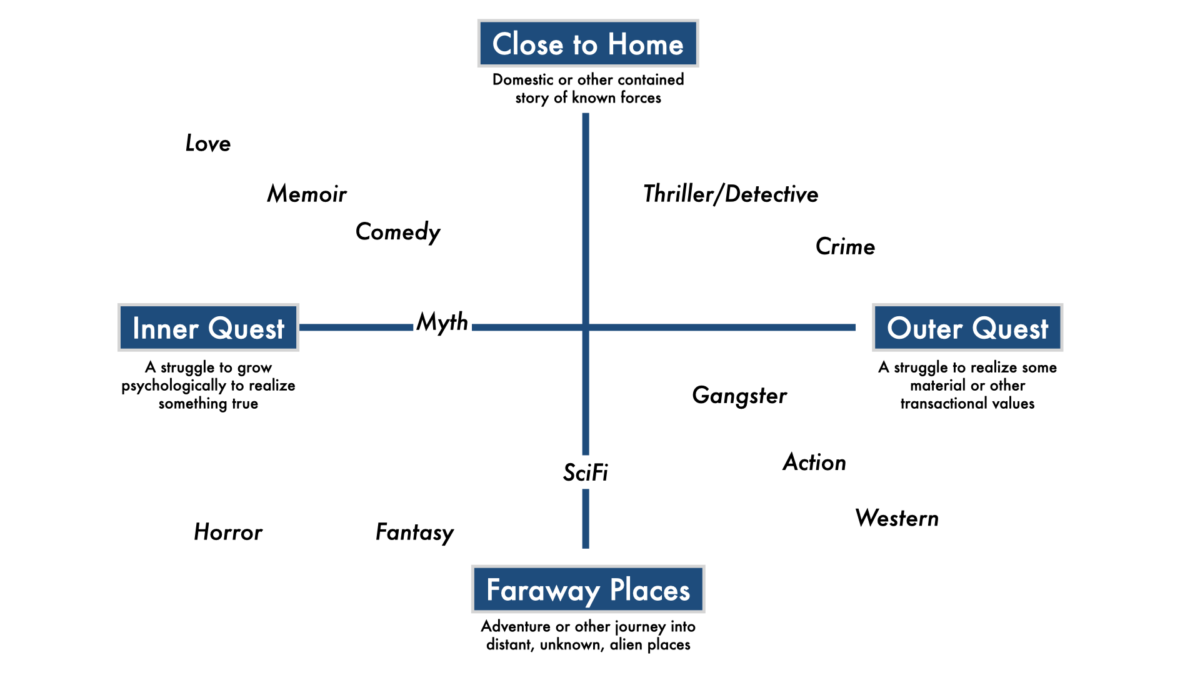
 So far, so good.